

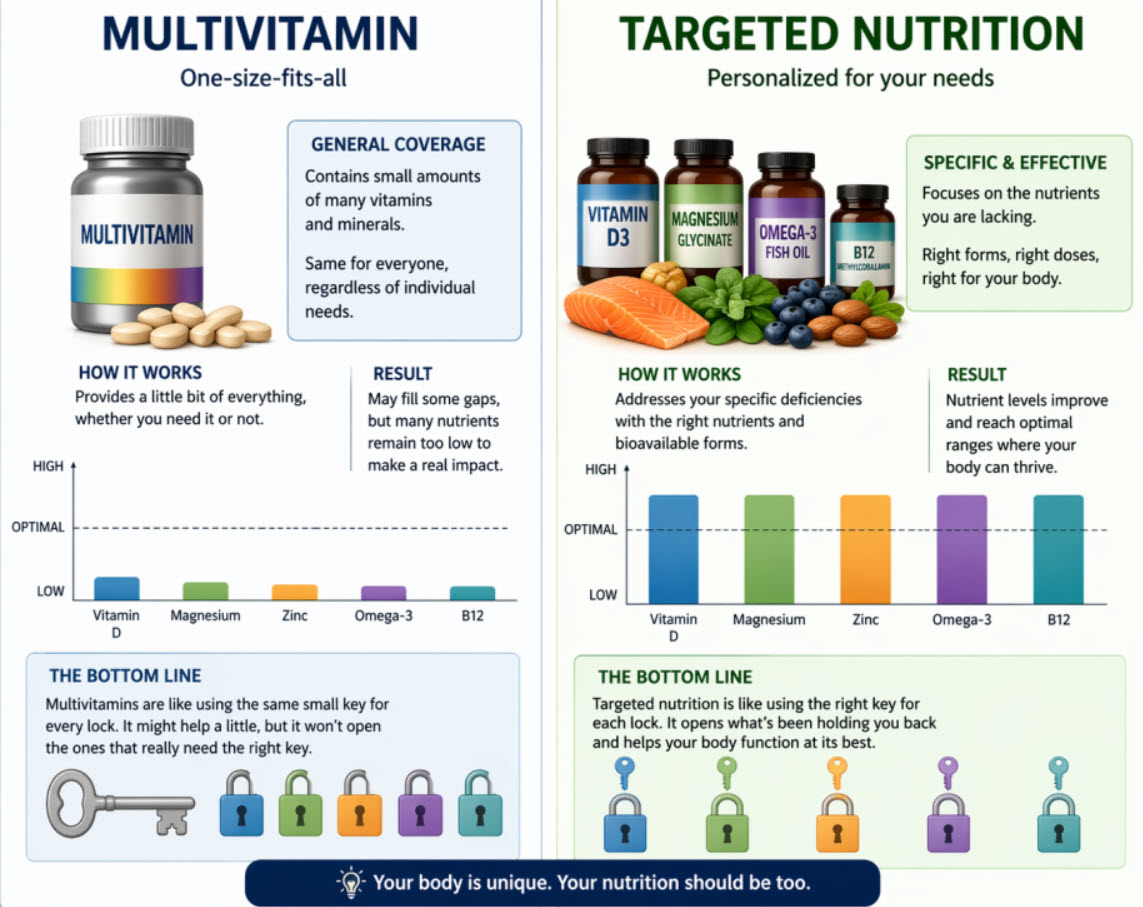
A recent study has drawn attention for suggesting that a simple daily multivitamin may slow biological aging. While that finding is interesting, it points to a deeper and more important truth:
Nutrition matters—but precision matters more.
What the Study Showed
Researchers followed nearly 1,000 older adults for two years and found:
- A daily multivitamin slowed biological aging by about four months
- Aging was measured using epigenetic markers (DNA methylation patterns)
- The greatest benefit was seen in those aging faster biologically
This confirms that nutritional status directly affects how the body ages at a cellular level.
The Limitation of Multivitamins
A multivitamin is, by definition, a broad, non-specific approach.
It assumes:
- Everyone has similar deficiencies
- Everyone needs the same nutrients in the same amounts
But clinically, that’s not what is observed.
In reality:
- One person may need vitamin A and zinc
- Another may need magnesium and B vitamins
- Another may have issues with absorption, not intake
So while a multivitamin may provide a small benefit, it is often:
- Under-dosed where support is needed
- Over-inclusive where it’s not needed
- Not targeted to the individual
Why Targeted Nutrition Is More Effective
The body doesn’t age because it lacks “a little bit of everything.”
It ages due to specific breakdowns, such as:
- Chronic inflammation
- Oxidative stress
- Hormonal imbalance
- Poor glucose regulation
- Nutrient deficiencies unique to the individual
Correcting these requires precision, not generalization.
How to Identify What the Body Actually Needs
Two highly effective approaches include:
1. Functional Blood Work
Blood chemistry can reveal:
- Nutrient deficiencies
- Inflammatory markers
- Blood sugar imbalances
- Liver and metabolic stress
When interpreted properly, it gives a roadmap of where dysfunction is occurring.
2. Vega-Style Testing (Reflex-Based Testing)
Using reflex-based testing methods (such as leg-length or arm reflex checks), the body can be assessed for:
- Nutrient stressors
- Organ weaknesses
- Immune challenges
- Food sensitivities
This allows for real-time feedback on what the body is responding to and what it needs most.
A Better Strategy for Slowing Aging
Instead of relying on a general multivitamin, a more effective approach includes:
- Identifying individual deficiencies and imbalances
- Supporting key nutrients based on need, not assumption
- Monitoring response over time
- Adjusting protocols as the body improves
Common nutrients often involved in aging support include:
- Vitamin A – critical for cellular repair and tissue integrity
- Vitamin D – regulates immune function and inflammation
- Magnesium – supports hundreds of enzymatic processes
- B vitamins – essential for energy and DNA repair
- Zinc – supports immune and cellular function
But again—the key is not guessing. The key is testing and targeting.
The Real Takeaway
The study confirms that nutrition influences aging.
But the real clinical insight is this:
A general multivitamin may help a little—
but targeted nutrition can change the trajectory.
Bullet Point Summary
Click here to read full article
- Multivitamins showed a modest slowing of biological aging
- Aging is driven by specific physiological imbalances, not general deficiency
- Multivitamins are non-specific and often inefficient
- Functional blood work helps identify true deficiencies and dysfunction
- Vega-style reflex testing can pinpoint individual nutritional needs
- Targeted nutrition is far more effective than a one-size-fits-all approach
- Precision-based care offers the best path to improved healthspan
Nutritional Support
The most effective nutritional strategies are those tailored to the individual.
Access professional-grade supplements here:
https://us.fullscript.com/welcome/jkeefe-dc
These products are selected to support:
- Cellular repair and longevity
- Inflammatory balance
- Individualized nutrient restoration
Keefe Clinic
5016 S. 79th E. Avenue
Phone: 918-663-1111
Fax: 918-663-2129
Email: docjohn@keefeclinic.com