

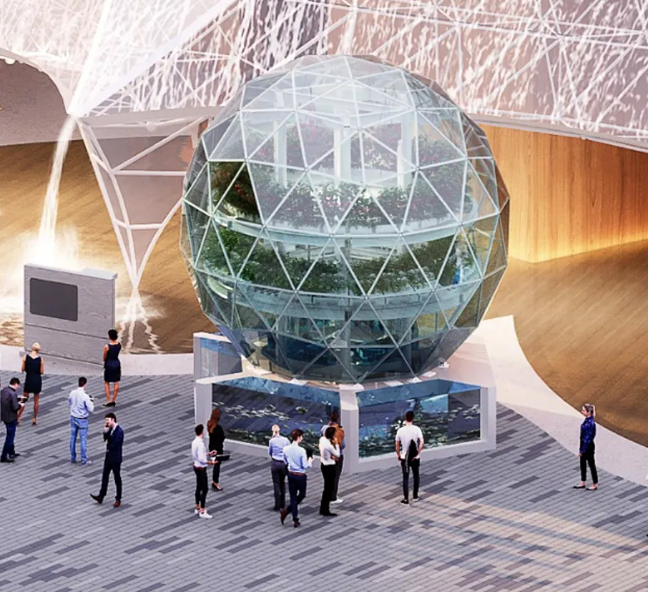
As cities grow larger and space becomes tighter, one question keeps coming up: how will we grow fresh food close to where people live? A futuristic project unveiled at Expo 2025 in Osaka, Japan offers one possible answer—a compact, self-contained food dome that works like a miniature ecosystem.
Known as the “Source of Life” dome, this structure shows how food production could move onto rooftops, schools, and apartment buildings instead of relying only on distant farms.
A Mini Ecosystem Under One Roof
At first glance, the dome looks like a small greenhouse. Inside, however, it functions as a fully integrated food system. Fish, plants, microbes, water, and sunlight all work together in a closed loop that produces almost no waste.
The dome is about 21 feet tall and is built around four water zones:
- Seawater
- Brackish water
- Freshwater
- Clean return water
Each zone supports different types of fish. As the fish produce waste, naturally occurring microbes convert that waste into nutrients plants can use. Those nutrients are then pumped upward to stacked plant layers.
Above the water tanks, plants grow in hydroponic tiers, meaning no soil is required. Salt-tolerant greens grow above seawater. Tomatoes and other vegetables thrive above brackish water. Herbs and lettuce grow above freshwater fish. Edible flowers sit at the top, where sunlight is strongest.
The design mirrors how ecosystems transition from ocean to land in nature.
How the System Stays Balanced
The dome uses transparent ETFE panels to let in sunlight while keeping temperatures stable. Water continuously cycles upward to feed plants and then flows back down, cleaned by plant roots and microbes before returning to the fish tanks.
Because everything is reused—water, nutrients, and energy—the system needs very little outside input once it is running. There is no soil depletion, no fertilizer runoff, and no dependence on weather.
Why This Matters for Cities
If systems like this can be scaled, cities could shift food production from large, distant farms to many small local sites. Rooftops, schoolyards, and unused urban spaces could all become food sources.
This approach offers several benefits:
- Shorter supply chains, meaning fresher food
- Less dependence on trucking and shipping
- Greater food security during disasters
- More transparency, since people can see how their food is grown
Instead of one massive farm feeding a city, hundreds of small systems could share the load.
Learning From Nature
The dome was designed by researchers from Osaka Metropolitan University and the Tokyo University of Marine Science and Technology. Their goal was not to invent a new process, but to copy how healthy ecosystems already work, especially wetlands where waste from one organism becomes food for another.
By letting biology do most of the work, the system reduces strain on land, water, and energy resources.
What This Could Mean for You
In the future, a food dome like this could sit on top of an apartment building, school, or community center. It could provide herbs, leafy greens, vegetables, and even edible flowers just steps away from where people live.
For people without access to farmland—or even a backyard—this model offers a realistic way to grow clean, fresh food year-round. In emergencies, when transportation is disrupted, these closed-loop systems could keep producing food locally.
Looking Ahead
The Source of Life dome is still a prototype, but it offers a clear glimpse into how food production might change. By combining architecture, aquaculture, and ecology into one compact system, it shows that future cities may not need to choose between density and sustainability.
If adopted widely, food domes could help millions of people reconnect with where their food comes from—without leaving the city.